

How to Choose an Obesity Doctor in Rochester: Credentials and Red Flags
Anyone with a medical licence can advertise weight loss services. That is worth knowing before you choose.
Training in obesity medicine is a specific qualification, and most physicians offering weight loss care do not hold it. Knowing how to choose an obesity doctor in Rochester means knowing what to verify, what to ask, and what should give you pause. This guide explains all three, including how to check any physician’s credentials independently.
What Obesity Medicine Certification Actually Is
This credential exists, and most patients have never heard of it.
The American Board of Obesity Medicine certifies physicians specifically in this field. Certified physicians are called diplomates, and the requirements are substantial.
To qualify, a physician must hold an active unrestricted medical licence, have completed residency training in the United States or Canada, and already hold board certification through an American Board of Medical Specialties member board or the osteopathic equivalent. They must then complete additional education and pass a certification examination.
That prerequisite matters. A genuine obesity medicine diplomate necessarily holds a second board certification as well, typically in internal medicine, family medicine, or a related field.
Certification also expires after ten years, requiring recertification. It is therefore a current qualification rather than a one-time achievement.
Why the Number of Certified Physicians Is Small
Context helps here. According to figures published by the board, roughly eight thousand physicians across the United States and Canada held this certification as of the most recent widely reported count.
Against the total number of practising physicians in North America, that is a small proportion. Obesity affects an enormous number of people, while relatively few physicians have trained formally in treating it.
Consequently, finding a certified physician locally is genuinely meaningful rather than a marketing distinction. It also explains why so many patients report feeling dismissed, since most physicians received minimal training in obesity management.
How to Verify Credentials Yourself
You do not need to take anyone’s word for this, and verification takes a few minutes.
The Obesity Medicine Directory
The American Board of Obesity Medicine maintains a public directory of diplomates at abom.org/diplomates. You can search by physician name, or by city and state to see who is certified near you.
The directory also allows downloading a primary source verification document, which confirms certification directly from the board rather than from the physician’s own marketing.
Their Other Board Certification
Since obesity medicine certification requires an existing ABMS board certification, that second credential should be verifiable too. The American Board of Medical Specialties operates a public verification service for this purpose.
State Licence Status
The New York State Office of the Professions maintains a public licence verification search covering physicians practising in the state. This confirms an active licence and shows any disciplinary history on record.
A Note on Board Eligible
If a practice describes its physician as board eligible in obesity medicine, that phrase deserves scrutiny. The board itself does not use the term, stating that it lacks a consistent definition.
A physician is either certified or not. Anything described in between is worth clarifying directly.
Who Else Can Provide This Care
An obesity medicine physician is not the only appropriate option, and being honest about that matters.
Primary care physicians: can prescribe weight loss medication and manage straightforward cases. Comfort with these medications varies considerably, and some prefer to refer.
Nurse practitioners and physician assistants: can prescribe within their scope of practice, and New York permits experienced nurse practitioners to practise independently. Many are excellent, and some hold obesity medicine training themselves.
Endocrinologists: specialise in hormonal conditions and are particularly relevant where thyroid disease, diabetes, or other endocrine problems dominate the picture.
Registered dietitians: provide nutrition expertise that physicians often lack in depth. They cannot prescribe, so they typically work alongside medical care rather than replacing it.
Bariatric surgeons: appropriate when surgery is genuinely the better option, which it is for some patients. A good obesity medicine physician refers rather than competing.
The right choice depends on your situation. Someone with straightforward needs and a comfortable primary care relationship may need nothing further. Complexity, multiple conditions, or previous unsuccessful attempts point toward specialised care.
Red Flags Worth Taking Seriously
Several practices in this field operate in ways that should give patients pause.
Proprietary Supplements as the Treatment
Clinics selling their own branded supplements as a central part of the programme have a financial interest in recommending them. Evidence for most weight loss supplements is weak, and the conflict of interest is direct.
No Laboratory Testing Before Prescribing
Thyroid dysfunction, insulin resistance, and kidney or liver problems all affect treatment decisions. Prescribing without establishing these is not thorough care, and it occasionally misses conditions that explain the weight entirely.
Compounded Medications From Unverified Sources
Compounded versions of weight loss medications are not FDA-approved, and the agency has raised concerns including dosing errors that resulted in serious adverse events. If a clinic offers one, ask specifically what you are receiving and why the approved version is not being used.
Guaranteed Results
No honest clinician can promise a specific outcome. Individual responses vary considerably, and guarantees indicate marketing rather than medicine.
HCG for Weight Loss
HCG is not FDA-approved for weight loss, and the agency has cautioned against products marketed this way. Its continued promotion suggests a practice prioritising sales over current evidence.
Rotating Providers
Seeing a different clinician at every visit prevents anyone from accumulating a full picture of your history. Continuity matters particularly in a condition treated over months and years.
No Plan for What Happens Afterward
Programmes ending at a goal weight with no maintenance strategy tend to produce the cycle patients are trying to escape. Ask what happens after, and be wary if there is no clear answer.
Questions Worth Asking
A first consultation is also your assessment of them. These questions surface most of what matters.
- Are you certified by the American Board of Obesity Medicine, and what other board certifications do you hold?
- What laboratory testing do you order before recommending treatment?
- Will I see you at each visit, or different providers?
- Do you sell supplements or products, and do they form part of the programme?
- Are the medications you prescribe FDA-approved, or compounded?
- Who manages my other conditions and adjusts related medications as I lose weight?
- What happens once I reach my goal, and what does maintenance involve?
- How do you handle insurance verification and prior authorisation?
Their willingness to answer these directly tells you as much as the answers themselves.
What Good Care Looks Like
Beyond credentials, several features distinguish thorough practice.
Evaluation comes before treatment, including history, medications, laboratory testing, and body composition assessment. Treatment addresses underlying causes rather than weight alone, since thyroid dysfunction, insulin resistance, sleep apnea, and medication effects all require identification.
The approach should be individualised rather than a standard programme applied uniformly. Follow-up should be regular, with the plan adjusting as your body responds. Related conditions should be managed alongside your weight, since medications frequently need modification as appetite and weight change.
Finally, good care includes honest expectations. A physician telling you what treatment realistically achieves, including its limits, is more trustworthy than one promising transformation.
Practical Considerations in Rochester
A few local factors are worth weighing alongside credentials.
Insurance participation matters considerably, since coverage affects both consultations and medication access. Ask whether the practice verifies benefits before you begin and whether they handle prior authorisation submissions, since that process determines whether many patients can access treatment at all.
Referral requirements vary by plan rather than by practice. Many clinics accept patients directly, though confirming your own plan’s rules avoids coverage problems.
Location and scheduling matter more than people expect for a condition requiring ongoing visits over months. A practice that is convenient enough to attend consistently outperforms a more distant one you eventually stop visiting.
About Vital Health Medical Care
Applying the above to this practice, here is what you can verify independently.
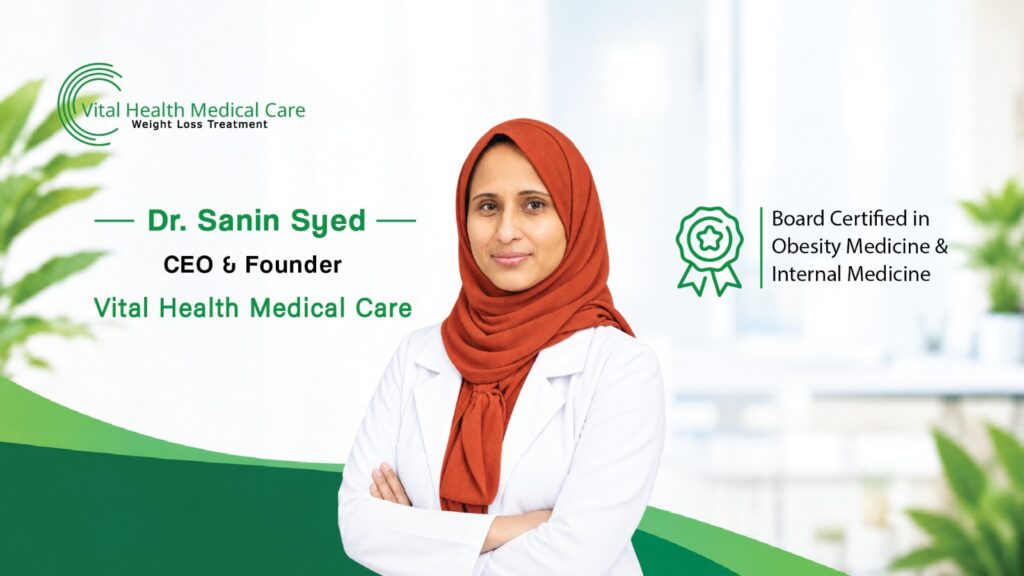
Dr. Sanin Syed holds certification from the American Board of Obesity Medicine and the American Board of Internal Medicine, which you can confirm through the directories described earlier rather than taking this page’s word for it. She brings over 20 years of clinical experience and teaches as an Assistant Professor of Medicine at the University of Rochester Medical Center. Her work in obesity medicine has been featured on NPR’s Evan Dawson Show and at the Rochester Academy of Medicine.
How Care Works Here
Evaluation includes history, medications, laboratory testing, and body composition analysis before any treatment recommendation. You see Dr. Syed rather than a rotating panel, and related conditions are managed alongside your weight given her internal medicine certification.
Practical Details
The practice is located at 10 Office Parkway, Suite 100 in Pittsford, minutes from downtown Rochester and serving Monroe County. Most major insurance plans are accepted, benefits are verified before you begin, and no referral is required.
What We See in Practice
Patients frequently arrive having tried a programme that sold them supplements, or one where they never saw the same person twice. Several describe being prescribed medication without any laboratory testing. Those experiences are common enough that knowing what to look for genuinely protects people, which is the purpose of this guide.
Frequently Asked Questions
What is an obesity medicine doctor?
A physician certified by the American Board of Obesity Medicine, which requires an active unrestricted licence, completed residency training, an existing board certification through an ABMS member board or osteopathic equivalent, and passing a certification examination. Certification lasts ten years before recertification is required, so it reflects current qualification.
How do I verify a doctor’s obesity medicine certification?
The American Board of Obesity Medicine maintains a public directory of diplomates at abom.org/diplomates, searchable by name or by city and state. You can also download a primary source verification document confirming certification directly from the board. The New York State Office of the Professions separately verifies licence status.
Do I need a specialist, or can my regular doctor help?
Many primary care physicians can prescribe weight loss medication and manage straightforward cases, though comfort with these medications varies. Specialised care makes more sense where there are multiple conditions, previous unsuccessful attempts, or complexity requiring coordination. A consultation can clarify which applies to you.
What does board eligible mean in obesity medicine?
The board itself does not use this term, stating that it lacks a consistent definition. A physician is either certified or not. If a practice describes its clinician as board eligible, asking directly whether certification has been completed is reasonable.
What are the warning signs of a weight loss clinic to avoid?
Watch for proprietary supplements sold as central to the programme, prescribing without laboratory testing, compounded medications from unverified sources, guaranteed results, HCG promoted for weight loss, rotating providers, and no maintenance plan. Each suggests a practice prioritising sales over evidence-based care.
Should a weight loss doctor order blood tests first?
Yes. Thyroid dysfunction, insulin resistance, and kidney or liver problems all affect treatment decisions and occasionally explain the weight entirely. Prescribing without establishing these is not thorough care. Testing typically covers thyroid function, blood sugar, lipids, and organ function.
What questions should I ask at a first appointment?
Ask about board certifications, what testing is ordered before treatment, whether you will see the same clinician each visit, whether the practice sells products, whether medications are FDA-approved or compounded, who manages your other conditions, what maintenance involves, and how insurance verification is handled.
Where can I find an obesity medicine physician near Rochester?
The American Board of Obesity Medicine directory allows searching by city and state to find certified physicians locally. Vital Health Medical Care in Pittsford is one option, where Dr. Sanin Syed holds certification in both obesity medicine and internal medicine. Call 585-662-5786 to schedule a consultation.
Getting Started
Choosing well matters more in this field than in many, since the standard of care varies considerably. Verifying credentials takes a few minutes, and asking good questions at a first visit takes little longer.
To schedule a consultation with Dr. Sanin Syed, call 585-662-5786 or visit vitalhealthmedicalcare.com. No referral is required. Our team will also verify your insurance benefits before you begin.
Meet Dr. Sanin Syed – Leading Medical Weight Loss Specialist in Rochester, NY
Dr. Sanin Syed, founder and CEO of Vital Health Medical Care, is a board-certified obesity and internal medicine specialist. With over two decades of experience, Dr. Syed is dedicated to helping her patients achieve lasting weight loss and a healthier lifestyle.
- Recognized Expertise: Dr. Syed’s knowledge has been featured on NPR’s Evan Dawson Show and in the Rochester Academy of Medicine.
- Commitment to Patient Health: She focuses on building sustainable health habits and lifestyle changes that support long-term success.
Our clinic, located at 10 Office Parkway, Suite 100, Pittsford, NY, provides a welcoming and professional setting for patients who are ready to make positive changes.
Why Choose Vital Health Medical Care?
Experienced Weight Loss Doctor
Dr. Sanin Syed is one of the leading weight loss doctors in New York, with over 20 years of experience in medicine and obesity management. She holds dual board certifications from the American Board of Obesity Medicine and the American Board of Internal Medicine, ensuring you receive the highest standard of care.
Personalized Care
At Vital Health Medical Care, we believe in a personalized approach to weight loss. Our programs are tailored to meet your unique needs, ensuring you receive the best possible care and support on your weight loss journey.
Comprehensive Support
We provide ongoing support throughout your weight loss journey, including regular monitoring and adjustments to your plan as needed. Our comprehensive approach ensures you have the resources and guidance necessary to achieve your weight loss goals.
Insurance Acceptance
We understand that managing healthcare costs is important. That’s why we accept a wide range of insurance plans to make our weight loss treatments accessible and affordable for everyone.
Nutritional Counseling
Our qualified nutritionists create personalized diet plans that fit your lifestyle and dietary preferences. We provide expert guidance on making healthy food choices that support your weight loss goals.
Physician Consultation
Our experienced physicians, led by Dr. Syed, will work with you to find the best medication and treatment plan for your needs. We utilize FDA-approved medications such as Wegovy and Zepbound to support your weight loss efforts.
Health Coaching
Our health coaches provide ongoing support and motivation, helping you stay on track with your weight loss goals. They offer practical advice and encouragement to help you overcome challenges and achieve lasting success.
Culinary Medicine
Learn how to prepare healthy, delicious meals that support your weight loss journey with guidance from our culinary medicine experts. We offer cooking classes and workshops to help you develop the skills needed to maintain a healthy diet.
Meal Replacement
We offer meal replacement options that are nutritious and convenient, helping you manage your calorie intake effectively. Our meal replacements are designed to support your weight loss goals while ensuring you receive essential nutrients.
Individualized Exercise Plan
Our fitness experts develop personalized exercise plans tailored to your fitness level and goals. We provide guidance on the best types of exercise for weight loss and overall health, ensuring you achieve optimal results.
Comprehensive Weight Loss Treatment in Rochester, New York
Vital Health Medical Care offers evidence-based weight loss treatments designed to help you succeed. We take a holistic approach, integrating medication, diet, exercise, and behavioral changes to ensure long-term success. Contact us today to schedule a consultation and start your journey.