

Postmenopausal Weight Loss Doctor in Rochester, NY: How to Protect Bone and Muscle
Most weight loss advice for women after menopause is just standard advice with one word added. That gap matters. After menopause, two things happen at once. Bone loss speeds up. Muscle loss adds up. So losing weight the wrong way makes both problems worse.
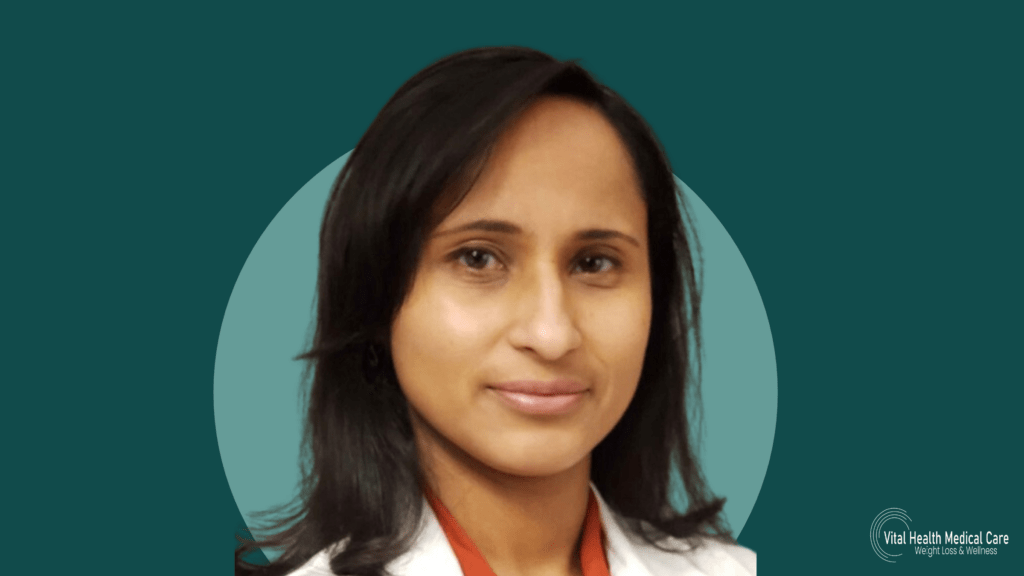
Most clinics skip this part. But it is the reason your care should measure more than pounds. Dr. Sanin Syed, MD leads Vital Health Medical Care in Pittsford. She holds dual board certification from the American Board of Obesity Medicine and the American Board of Internal Medicine. She also teaches as an Assistant Professor of Medicine at the University of Rochester Medical Center.
Her goal for patients after menopause is simple. Lose fat. Keep bone. Keep muscle. All three can be measured. Only one of them shows up on a scale.
The Short Answer
Weight loss after menopause works. But the method matters more than it used to.
Losing 5% to 10% of your body weight brings real gains. Blood pressure improves. Cholesterol improves. Blood sugar control improves. Joint pain often eases, and energy tends to rise.
Still, research in older women shows two costs. Weight loss speeds up bone loss at the hip. It also strips lean tissue along with fat. Neither finding argues against losing weight. Both argue for how you do it.
The fix has four parts: enough protein, strength training, a slower pace, and body composition testing instead of scale-watching. That combination is what sets a real postmenopausal weight loss doctor in Rochester apart from a general program.
What Changes After Your Last Period
Bone Loss Speeds Up
The SWAN study tracked bone density across the menopause transition. Bone changed little before and during early perimenopause. Then it dropped sharply in late perimenopause. The drop kept going through the first years after menopause.
In that study, spine bone loss averaged about 0.022 g/cm² a year after menopause, with hip loss near 0.013 g/cm². Those are group averages, so your own rate may differ.
One finding matters here more than the rest. In that same analysis, bone loss ran roughly 35% to 55% slower in the heaviest third of women than in the lightest third.
That is the awkward part. Extra body weight loads the skeleton, and loading protects bone. Lose weight, and you give up some of that protection. This does not mean you should stay heavy. The case for shedding excess fat is strong. But bone belongs in your plan from day one, not later.
Body Composition Settles
Another SWAN analysis followed women from about nine years before their last period to ten years after. Fat gain roughly doubled once the transition began. At the same time, lean mass started to fall. Then both changes stopped about two years after the final period.
For you, that plateau is good news, and few clinics say so. The steepest part is behind you. What remains is a body that settled into a worse ratio. More fat sits around the organs, and less muscle remains. That is a state you can treat, not a process still running away from you.
Heart and Metabolic Risk Rises
The fat you gained around menopause tends to settle deep in the belly. Doctors call it visceral fat. It sits around the organs rather than under the skin.
This type of fat carries stronger links to heart disease, type 2 diabetes, and metabolic syndrome. So a good doctor looks at where fat sits, not just at BMI. Two women can weigh the same and carry very different risk.
The Risk Nobody Mentions: Weight Loss and Your Bones
Read this part before you start any program.
The Study of Osteoporotic Fractures followed 6,785 older women. Researchers measured hip bone density by DXA scan and matched it to weight change.
In that study, hip bone density fell about 0.52% a year in women who gained weight. It fell about 0.68% a year in women whose weight held steady. And it fell about 0.92% a year in women who lost weight. The trend held whether or not the loss was on purpose.
These are observational findings in older women, not a trial of a modern medical program. So your own risk may differ. Still, the direction shows up again and again.
A 2016 review in Osteoporosis International pooled randomized trials and found a useful pattern. Cutting calories lowered hip bone density, alone or paired with exercise. But losing weight through exercise alone, without dieting, raised it.
So the message is not “skip the weight loss.” It is that your method decides whether you finish leaner and stronger, or leaner and more fragile. That is worth raising with a doctor who will actually measure it.
What Protects Bone While You Lose Weight
Exercise type seems to matter. A trial in The Journals of Gerontology compared strength training with cardio during calorie restriction in older adults. Strength training appeared to slow the loss of hip and femoral neck bone density. The authors noted that a larger, longer trial should confirm this.
Three other habits help. Eat enough protein. Get enough calcium and vitamin D. And lose weight slowly rather than fast.
Screening helps too. The U.S. Preventive Services Task Force recommends a DXA scan of the hip or spine for all women 65 and older. It also recommends one for younger women after menopause who face higher risk. So ask your doctor where you fall before you start.
The Second Risk: Muscle Loss on GLP-1 Medications
GLP-1 drugs work well. Many women after menopause do fine on them. But used without care, they carry a specific risk for you.
A 2024 review in Diabetes, Obesity and Metabolism pulled together the body composition data. In the STEP-1 trial, semaglutide cut lean mass by about 6.92 kg while total weight fell about 15.3 kg. So roughly 45% of the loss came from lean tissue.
In SURMOUNT-1, tirzepatide cut lean mass by about 5.67 kg against a total drop near 22.1 kg at the top dose. That works out to about 26% from lean tissue.
A later SURMOUNT-1 analysis in the same journal reported a split of roughly 75% fat and 25% lean. It also found the same ratio in the placebo group. So this ratio reflects fast weight loss in general, not the drug itself.
Two things follow from that. First, these numbers are normal for large weight loss by any route. In both trials, lean tissue actually rose as a share of the body, because fat fell faster.
Second, and this part is about you. After menopause, you are already losing muscle for age reasons. So the same percentage costs you more in absolute terms.
The good news is that you can manage it. Protein and strength training close most of the gap. But you have to measure it, which is why these drugs belong inside a supervised plan. Whether either drug suits you depends on your history, your other medicines, and your coverage, so a prescriber should review all three with you.
One Point of Accuracy on the Drug Names
Online marketing blurs this constantly. Wegovy holds FDA approval for long-term weight management. Ozempic contains the same drug, semaglutide, but the FDA approved it for type 2 diabetes. So using Ozempic for weight is off-label.
Zepbound holds FDA approval for long-term weight management. Since 2024, it also carries approval for moderate to severe sleep apnea in adults with obesity.
Sarcopenic Obesity: The Problem Most Clinics Miss
Some women after menopause carry too much fat and too little muscle at the same time. Doctors call this sarcopenic obesity.
It links to worse outcomes than either problem alone. Falls rise. Frailty rises. Daily function drops.
It also hides well. Your BMI can look fine. Your weight can look fine. Meanwhile the tissue underneath tells a different story.
This is where body composition testing earns its place. Vital Health Medical Care measures fat mass, lean muscle mass, visceral fat, hydration, and resting metabolic rate. In a patient after menopause, that answers three questions a scale cannot. Do you have enough muscle now? Is the weight coming off fat or muscle? And is the plan helping or quietly weakening you?
Simple function checks help as well. Watch your grip strength. Time how fast you walk. Then try rising from a chair without pushing off with your arms. If any of those slip, tell your doctor, because muscle loss has moved from a number into your daily life.
What a Real Evaluation Looks Like
Your Story and Your Timeline
The conversation teaches the doctor more than any single test. Expect questions about your last period and how long ago it came. Expect questions about your weight over the years. You will also cover past attempts, fractures, family hip fractures, current medicines, sleep, and any lingering hot flashes.
Dr. Syed brings over 20 years in internal medicine and obesity medicine to that step. Her internal medicine background matters here, because weight after menopause rarely stays a single-system problem.
Labs and Screening
A sensible first panel often covers thyroid function, HbA1c, fasting glucose, a lipid panel, a complete blood count, a metabolic panel, vitamin D, and calcium.
Bone density belongs in that conversation too, especially before a big weight loss push. Which tests apply to you depends on your history, so treat this as a starting point to discuss rather than a list to order alone.
What Actually Works After Menopause
Strength Training Comes First
For you, strength training does three jobs at once. It fights age-related muscle loss. It supports bone at the hip and spine while you lose weight. And it improves how your body handles blood sugar.
The American College of Sports Medicine advises at least two strength sessions a week. It also advises 150 to 300 minutes of moderate cardio.
Start small and get the form right. That beats starting big and quitting in March. If you have osteoporosis or a past fracture, some moves need changes, so raise it before you begin rather than after an injury.
Vital Health Medical Care sits across from the Jefferson and Clover Road YMCA in Pittsford. Nearby, you have Genesee Valley Park, the Erie Canal towpath, and the Lehigh Valley Trail for cardio. Your exercise plan matches your current ability and your joints, not an ideal version of them.
Protein, Calcium, and Vitamin D
Many groups suggest roughly 1.2 to 1.6 grams of protein per kilogram of body weight daily for older adults. That sits well above the general adult floor. Your right target depends on kidney function, activity, and health, so confirm it with your doctor.
Spread protein across your meals. Loading it all at dinner appears to help muscle less.
Calcium and vitamin D support bone during the years when loss speeds up. Vitamin D is worth measuring rather than guessing, especially through a Rochester winter when sun exposure drops for months.
Registered dietitians build the meal plans here. Dr. Syed also trained in lifestyle medicine, nutrition counseling, plant-based medicine, and culinary medicine. So the cooking classes bridge the gap between knowing your targets and hitting them on a Tuesday.
Go Slower on Purpose
Given the bone and muscle data, fast loss is the wrong call here. A steady pace with protein and strength work keeps more of what you want.
Programs that promise very fast results are describing water in the early weeks. After that, they cost you lean tissue.
Your target is also smaller than you expect. Research points to 5% to 10% of body weight for the health gains above. For a woman at 180 pounds, that means roughly 9 to 18 pounds.
Hormone Therapy: Real, But Not for Weight
Hormone therapy treats hot flashes and night sweats well. It also protects bone. So it matters for your health after menopause.
But the FDA has not approved it for weight loss, and the evidence does not support that use. If it fixes your sleep and lets you train again, your weight may improve as a side effect. That is a real benefit through a different route.
Whether it suits you depends on your years since menopause and your heart and breast health history. So take that one to your doctor.
Why Rochester Women Choose Vital Health Medical Care
Weight is a regional issue across upstate New York. New York State Department of Health survey data put adult obesity near 29.1% statewide. State analyses also place the Finger Lakes among the higher regions. Those figures rest on self-reported height and weight, so read them as a trend rather than an exact count.
Vital Health Medical Care opened in 2022 at 10 Office Parkway, Suite 100 in Pittsford. Patients come from Brighton, Penfield, Fairport, Webster, Victor, and downtown Rochester.
WXXI’s Connections with Evan Dawson has featured Dr. Syed’s work in obesity medicine. The Rochester Academy of Medicine also invited her to speak. She teaches residents and medical students at URMC, where the internal medicine residents gave her their Best Teacher Award. That URMC link helps when your care needs input from endocrinology, gynecology, or bone health.
Two practical notes. You do not need a referral to book. And the team checks your insurance benefits before you start, so you know your coverage up front.
Frequently Asked Questions
Is it harder to lose weight after menopause?
The mechanics change more than the difficulty does. After the transition, you carry more fat and less muscle, as the SWAN data showed. Less muscle burns fewer calories at rest.
But here is the encouraging part. The steepest phase is over, and muscle is a tissue you can rebuild. What truly changes is that your method now matters more, because the wrong one costs you bone and muscle you cannot spare.
Does losing weight after menopause weaken your bones?
It can, so plan for it rather than discover it later. In the Study of Osteoporotic Fractures, which followed 6,785 older women, hip bone density fell about 0.52% a year with weight gain, about 0.68% with stable weight, and about 0.92% with weight loss. The pattern held whether or not the loss was intentional.
That argues for the right method, not against losing weight. Use strength training, enough protein, calcium and vitamin D, and a slower pace. Also learn your bone density first. The USPSTF recommends a DXA scan for all women 65 and older, and for younger women after menopause at higher risk, so ask where you fall.
Should I worry about muscle loss on Wegovy or Zepbound?
Stay aware rather than worried, because you can manage this. A 2024 review in Diabetes, Obesity and Metabolism found that about 45% of the weight lost came from lean tissue in STEP-1 with semaglutide, and about 26% in SURMOUNT-1 with tirzepatide.
A later SURMOUNT-1 analysis found the same rough 75% fat to 25% lean split in the placebo group. So the ratio reflects fast weight loss in general.
You start with less muscle in reserve, so the same percentage costs you more. Protein, strength training, and body composition checks close much of that gap. That is exactly why these drugs belong in a supervised plan.
What is sarcopenic obesity, and could I have it?
It means too much fat and too little muscle at the same time. The pairing links to more falls, more frailty, and worse function than either problem alone.
Doctors miss it often after menopause, because BMI and scale weight can both look normal. Body composition testing finds it directly. Simple checks help too: grip strength, walking speed, and rising from a chair without your arms.
Will hormone replacement therapy help me lose weight?
No, and the evidence does not support that use. Hormone therapy is not an approved weight loss treatment.
It does treat hot flashes and night sweats well, and it protects bone. If better symptoms restore your sleep and your training, your weight may improve indirectly. That is a genuine benefit, but a different claim than some clinics make. Your fit depends on your symptoms, your years since menopause, and your heart and breast health history.
How much weight should I aim to lose?
Less than you think. Research points to a sustained 5% to 10% of body weight for the gains in blood pressure, cholesterol, blood sugar, joint pain, and energy. At 180 pounds, that means roughly 9 to 18 pounds.
Given the bone and muscle issues here, a moderate goal reached steadily beats a bigger one reached fast. Setting that goal correctly also predicts whether you are still going a year from now.
What should I ask a doctor before starting?
Three questions separate a real program from a general one.
First, how will you measure whether I lose fat or muscle? Second, how will you protect my bone density? Third, what protein target are you setting, and why?
A clinic that tracks only weight, has no answer on bone, and treats strength work as optional is not built for your stage.
How long before I see results?
Body composition often improves before the scale moves. Strength gains from training show up within four to six weeks for many people.
GLP-1 trials measured their main results at 68 to 72 weeks, with slow dose increases along the way. Bone density shifts slowly, so doctors usually recheck it in years, not months.
Anyone who promises a fixed timeline before knowing your starting point is guessing. An honest talk about expectations predicts your success better than any promised number.
The Bottom Line
Weight loss after menopause is worth doing, and you can do it. What changes is that you now have three things to protect instead of one.
Fat should come down. Muscle should hold. And you should know your bone status before you start.
That takes a different kind of plan. Strength training becomes the base, not an add-on. Protein targets get set on purpose. The pace stays moderate by design. Medication, where it fits, comes with body composition checks beside it. And the goal matches what the evidence supports rather than what sells.
Dr. Sanin Syed offers dual board certification in obesity medicine and internal medicine, over 20 years of practice, and a URMC faculty role. Her program brings together medical review, body composition testing, dietitian support, culinary medicine, exercise planning, and coaching in one place.
Meet Dr. Sanin Syed – Leading Medical Weight Loss Specialist in Rochester, NY
Dr. Sanin Syed, founder and CEO of Vital Health Medical Care, is a board-certified obesity and internal medicine specialist. With over two decades of experience, Dr. Syed is dedicated to helping her patients achieve lasting weight loss and a healthier lifestyle.
- Recognized Expertise: Dr. Syed’s knowledge has been featured on NPR’s Evan Dawson Show and in the Rochester Academy of Medicine.
- Commitment to Patient Health: She focuses on building sustainable health habits and lifestyle changes that support long-term success.
Our clinic, located at 10 Office Parkway, Suite 100, Pittsford, NY, provides a welcoming and professional setting for patients who are ready to make positive changes.
Why Choose Vital Health Medical Care?
Experienced Weight Loss Doctor
Dr. Sanin Syed is one of the leading weight loss doctors in New York, with over 20 years of experience in medicine and obesity management. She holds dual board certifications from the American Board of Obesity Medicine and the American Board of Internal Medicine, ensuring you receive the highest standard of care.
Personalized Care
At Vital Health Medical Care, we believe in a personalized approach to weight loss. Our programs are tailored to meet your unique needs, ensuring you receive the best possible care and support on your weight loss journey.
Comprehensive Support
We provide ongoing support throughout your weight loss journey, including regular monitoring and adjustments to your plan as needed. Our comprehensive approach ensures you have the resources and guidance necessary to achieve your weight loss goals.
Insurance Acceptance
We understand that managing healthcare costs is important. That’s why we accept a wide range of insurance plans to make our weight loss treatments accessible and affordable for everyone.
Nutritional Counseling
Our qualified nutritionists create personalized diet plans that fit your lifestyle and dietary preferences. We provide expert guidance on making healthy food choices that support your weight loss goals.
Physician Consultation
Our experienced physicians, led by Dr. Syed, will work with you to find the best medication and treatment plan for your needs. We utilize FDA-approved medications such as Wegovy and Zepbound to support your weight loss efforts.
Health Coaching
Our health coaches provide ongoing support and motivation, helping you stay on track with your weight loss goals. They offer practical advice and encouragement to help you overcome challenges and achieve lasting success.
Culinary Medicine
Learn how to prepare healthy, delicious meals that support your weight loss journey with guidance from our culinary medicine experts. We offer cooking classes and workshops to help you develop the skills needed to maintain a healthy diet.
Meal Replacement
We offer meal replacement options that are nutritious and convenient, helping you manage your calorie intake effectively. Our meal replacements are designed to support your weight loss goals while ensuring you receive essential nutrients.
Individualized Exercise Plan
Our fitness experts develop personalized exercise plans tailored to your fitness level and goals. We provide guidance on the best types of exercise for weight loss and overall health, ensuring you achieve optimal results.
Comprehensive Weight Loss Treatment in Rochester, New York
Vital Health Medical Care offers evidence-based weight loss treatments designed to help you succeed. We take a holistic approach, integrating medication, diet, exercise, and behavioral changes to ensure long-term success. Contact us today to schedule a consultation and start your journey.